The Red-tailed Hawk Project’s first publication has now been published in the Journal of Biogeography! The paper details spring migration routes, nesting locations and home ranges of four dark morphs tagged in the Great Lakes region of North America. These data support that dark morphs do indeed breed in eastern Boreal Canada, extending our understanding of the distribution of plumage polymorphism for this species around 1500 km eastward.
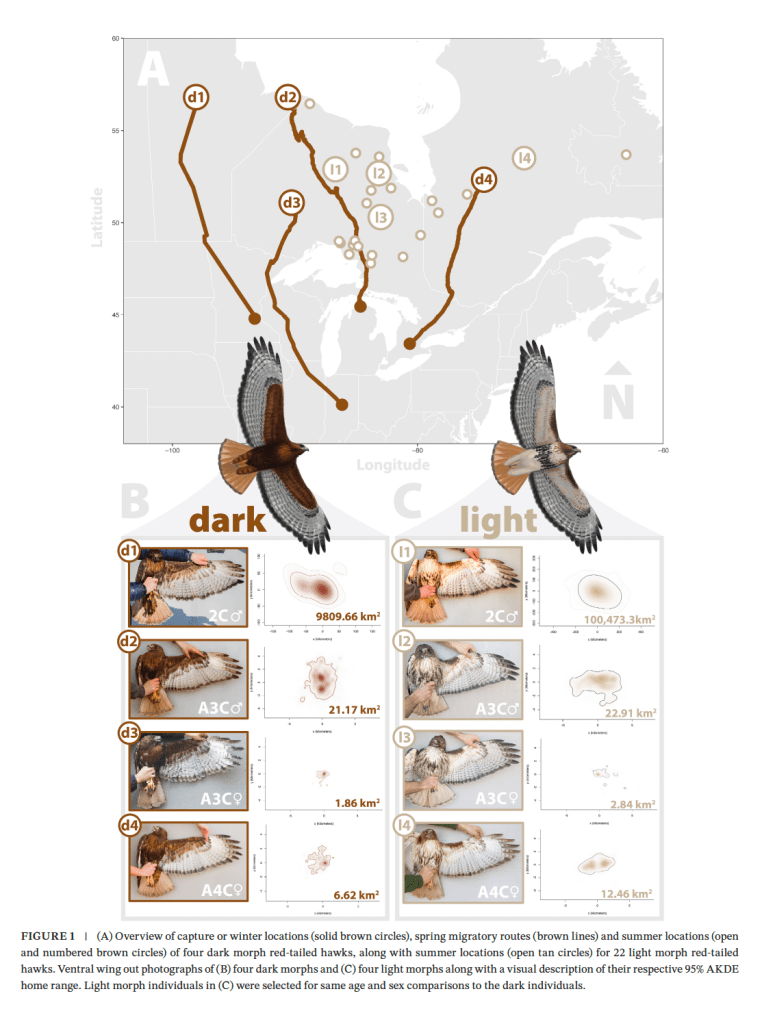
There are many notable things included in this paper, apart from the evidence to suggest that the subspecies abieticola possesses a rare dark morph. This paper provides the first robust details on home range size during nesting for the species, as well as a perspective on age of first breeding (a few third-cycle or 3 year old birds in our dataset seem to have conducted nesting activities, while some did not, and all second-cycle or 2 year old birds did not).

Another notable aspect described in our data is the significantly different home range size for nesting male and female hawks. This is expected, since males provision incubating females. Still, it is very fun to see it represented in the data!
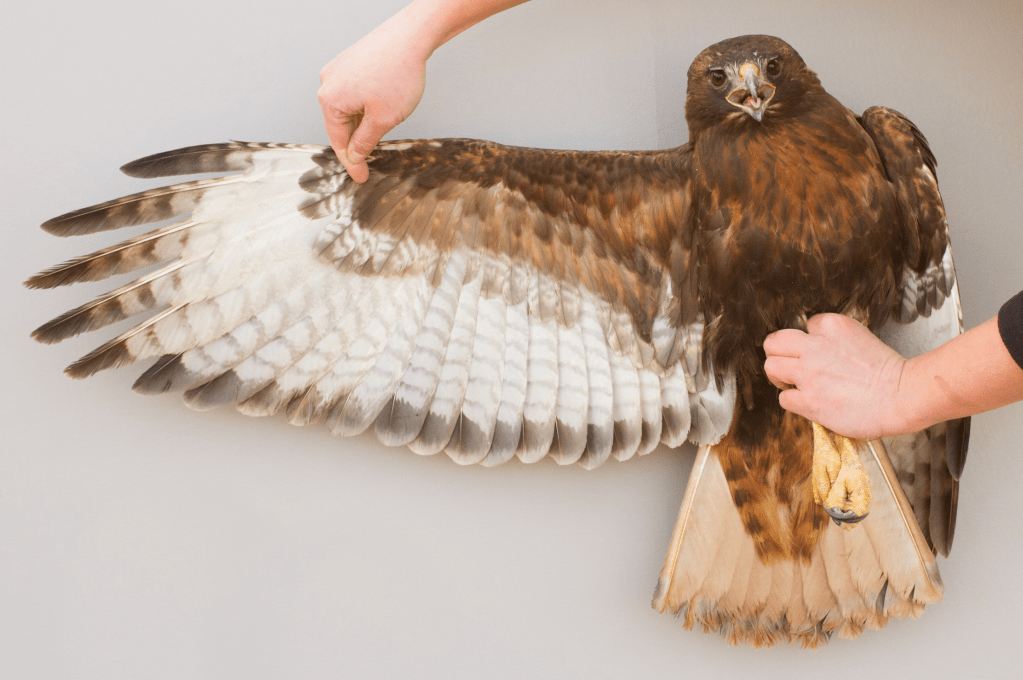
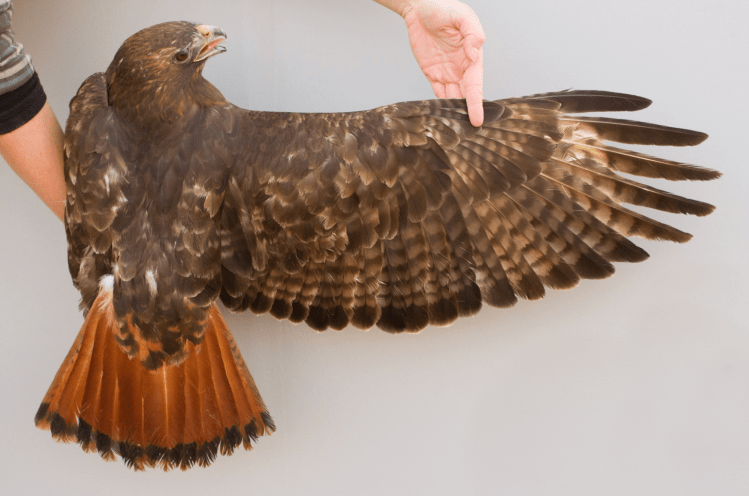
This paper is particularly exciting because of the inclusion of our standardized and comprehensive photographs of each individual that is included in the analyses in this paper (more photos of ‘Rose’ above, individual D4 in Figure 1 and the furthest east nesting dark morph Red-tailed Hawk, can be found in the Macaulay Library). In table 1 of the paper, we included the eBird checklists for each individual so the reader can easily explore the plumages and review our age assessments, for instance.
Finally, although we only include four dark individuals in this paper, we are extremely proud of that number because it represents hard work and collaboration. Our ability to create this publication only came through collaboration between Hawk Ridge Bird Observatory, Mackinac Straits Raptor Watch, and the Cornell Lab of Ornithology. Teamwork pays off!
You can read the paper online at https://doi.org/10.1111/jbi.15010
 Red-tailed Hawk Project
2 thoughts on “Published in the Journal of Biogeography – A revision to the distribution of plumage polymorphism in the Red-tailed Hawk (Buteo jamaicensis)”