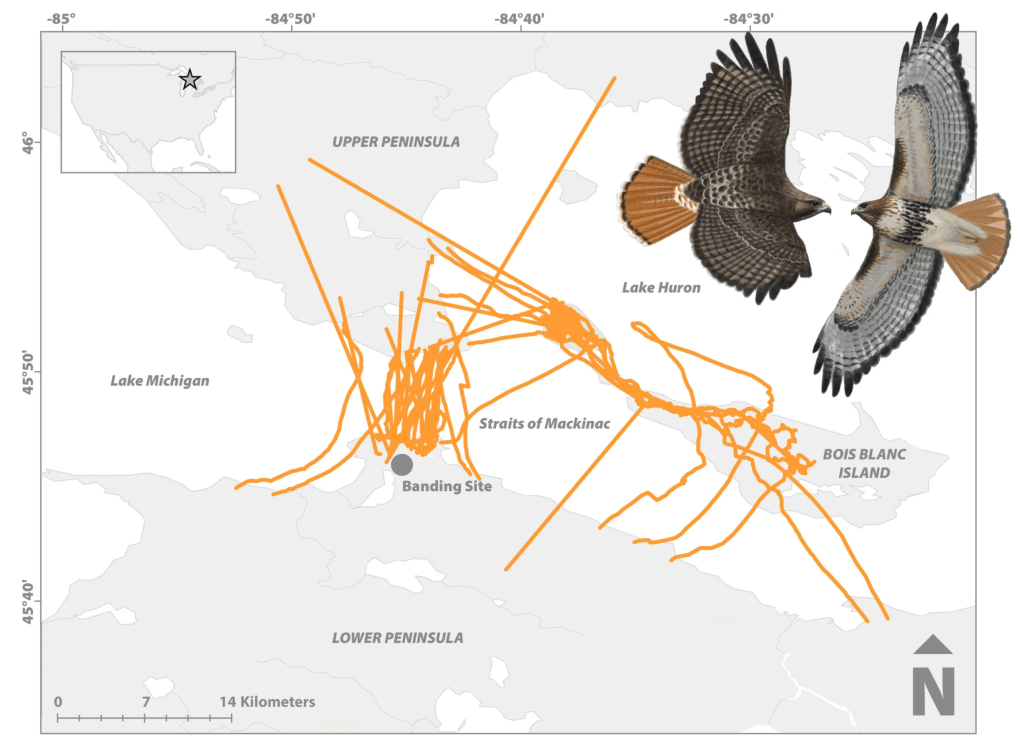
We are excited to share a new research article now published in Movement Ecology! In this paper we investigate how atmospheric conditions influenced the timing of water crossing for Red-tailed Hawks at the Straits of Mackinac in Michigan during spring migration. Specifically, we investigated the availability of over-water uplift and its effect on crossing behavior, which has only previously been assessed in the Eastern hemisphere during autumn migration. We also looked at the effects of wind speed, wind support and Julian day on the probability of crossing.
We found that over-water uplift was available in spring and that it positively affected the probability of crossing, and that low wind speeds and wind support increased the probability of crossing. Julian day was also an important predictor as hawks were more likely to cross earlier in the spring. We also saw that there was substantial variation in crossing behavior among individuals despite the general effects of over-water uplift and wind.

This paper is the first to highlight that over-water uplift is available to soaring migrants at a water barrier in the Western Hemisphere during spring migration. We also show that like other soaring raptors, low winds and wind support are important predictors influencing the decision to cross open water. Overall, we found that Red-tailed Hawks are flexible and can use varying conditions to cross open water. Our findings add to the growing body of research on how soaring raptors overcome water barriers during migration.
This work was a collaborative effort between the Mackinac Straits Raptor Watch, Michigan State University and the Cornell Lab of Ornithology.
You can download a PDF of the full open-access paper via this link: https://rdcu.be/eIXXH
 Red-tailed Hawk Project
it is just incredible the data you have begun to collect, Congratulations to all participating, Thank you for sharing.
LikeLike