Movement summary from our 2025 transmitters!

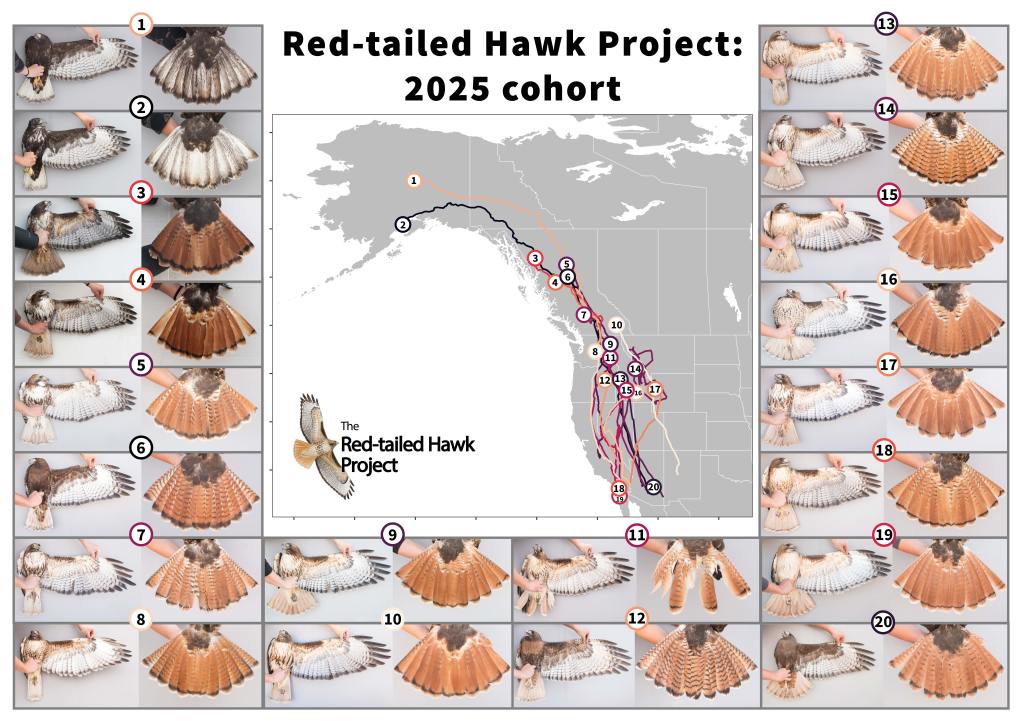
Spring movement paths (colored lines) and breeding/summer locations (colored circles with matching numbers) from 20 GPS tracked Red-tailed Hawks sampled in 2025.

Our transmitter efforts in 2025 focused primarily on expanding our knowledge of movement and plumage variation among Red-tailed Hawks in western North America. Our sampling predominately occurred during winter throughout the desert southwest of California, Arizona, and New Mexico and resulted in breeding origins from British Columbia, Washington, Oregon, Idaho, Montana, Wyoming, and a few resident (non-migratory) southwestern individuals. Desert southwest winter captures are numbered 5–20 in the above map. We also sampled wintering individuals from the Pacific Northwest (numbered 1–4 in the above map) resulting in two more harlani from Alaska and two non-harlani from British Columbia.

Genomic work is still pending, but we are particularly excited about our sampling of breeding locations from British Columbia where the breeding ranges of at least four subspecies meet: harlani, alascensis, calurus, and abieticola. British Columbia certainly represents an exciting frontier of genomic and plumage discovery, and we look forward to sharing future updates with everyone!

Thanks to the Holdfast Collective, Kidd Biological, Inc., Cornell Lab of Ornithology, and University of Idaho for supporting our transmitter efforts in 2025.

Published in Movement Ecology: Crossing the straits of Mackinac…

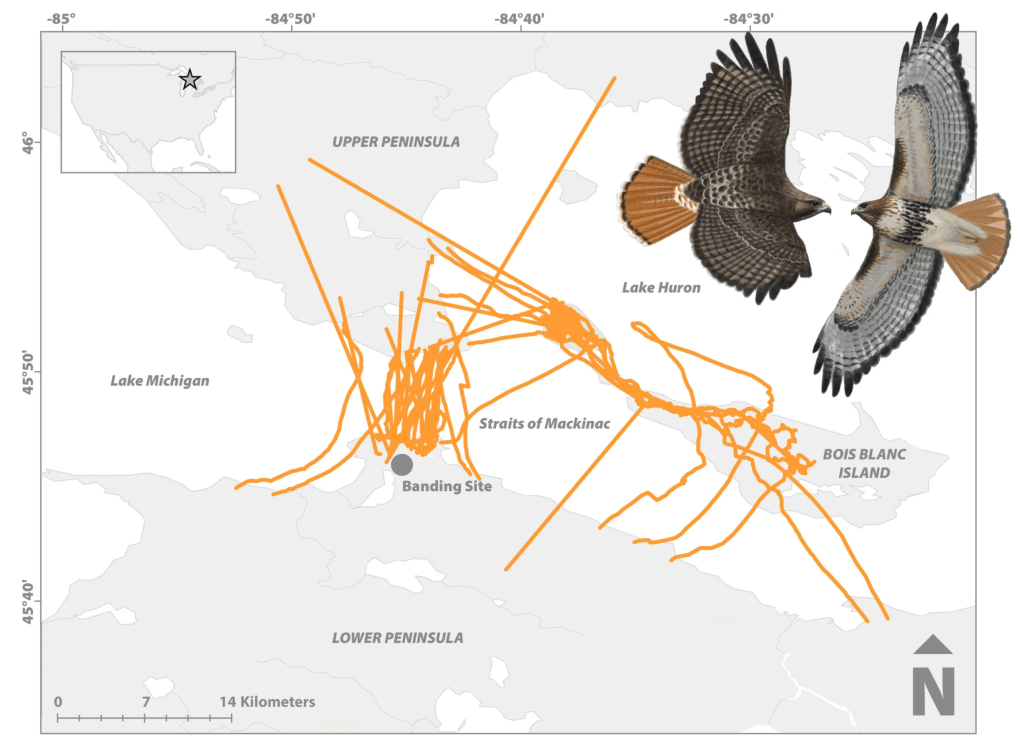
We are excited to share a new research article now published in Movement Ecology! In this paper we investigate how atmospheric conditions influenced the timing of water crossing for Red-tailed Hawks at the Straits of Mackinac in Michigan during spring migration. Specifically, we investigated the availability of over-water uplift and its effect on crossing behavior, which has only previously been assessed in the Eastern hemisphere during autumn migration. We also looked at the effects of wind speed, wind support and Julian day on the probability of crossing.

We found that over-water uplift was available in spring and that it positively affected the probability of crossing, and that low wind speeds and wind support increased the probability of crossing. Julian day was also an important predictor as hawks were more likely to cross earlier in the spring. We also saw that there was substantial variation in crossing behavior among individuals despite the general effects of over-water uplift and wind.

This paper is the first to highlight that over-water uplift is available to soaring migrants at a water barrier in the Western Hemisphere during spring migration. We also show that like other soaring raptors, low winds and wind support are important predictors influencing the decision to cross open water. Overall, we found that Red-tailed Hawks are flexible and can use varying conditions to cross open water. Our findings add to the growing body of research on how soaring raptors overcome water barriers during migration.

This work was a collaborative effort between the Mackinac Straits Raptor Watch, Michigan State University and the Cornell lab of Ornithology.


You can download a PDF of the full open-access paper via this link: https://rdcu.be/eIXXH

Published in the Journal of Raptor Research – Migratory connectivity of Red-tailed Hawks (Buteo jamaicensis) from Alaska, USA

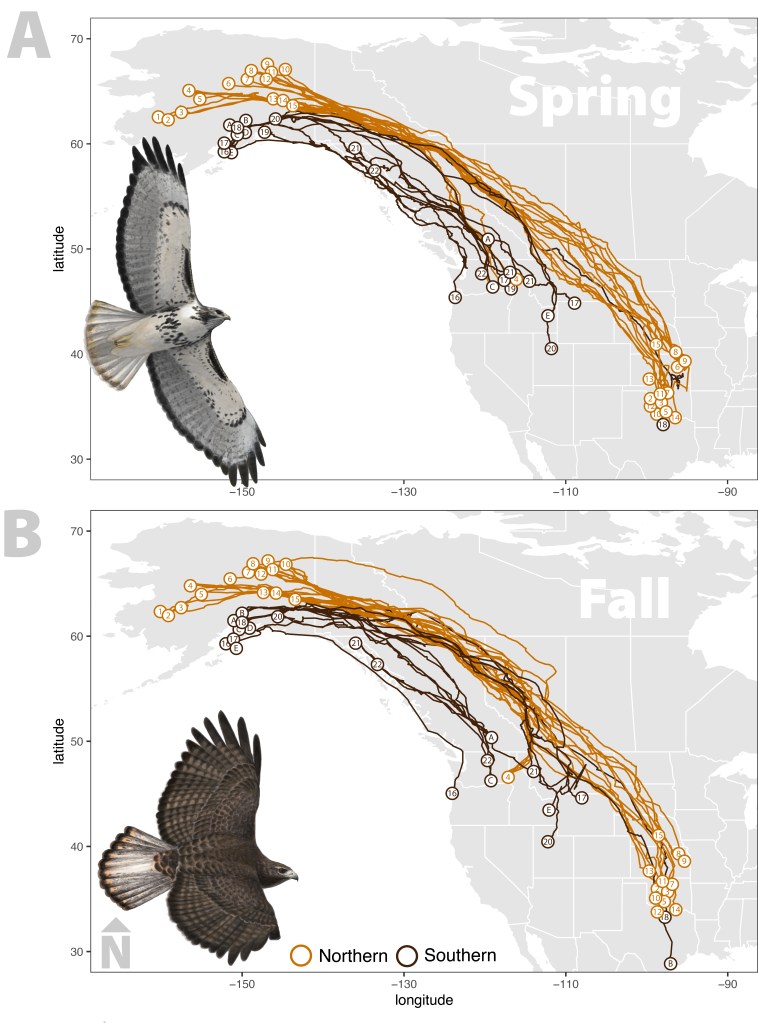
We are excited to announce the publication of a new research article for an upcoming movement ecology issue in the Journal of Raptor Research. In this paper, we detail the migratory behavior and plumage variation of GPS-tracked adult Red-tailed Hawks (Buteo jamaicensis) that summered in Alaska, USA.

We found significant levels of migratory connectivity among Alaska’s Red-tailed Hawks. Individuals that spent the breeding season in northern Alaska were more likely to migrate longer distances to overwintering locations in the Great Plains, USA, while individuals that spent the breeding season in southern Alaska were more likely to migrate shorter distances to overwintering locations in southwestern Canada and the western USA. We also noted significant differences in migratory routing between the two regions.

In addition, the standardized photographs for the 22 adults in this study strengthen our understanding of the plumage diversity present in Alaska. While we mostly tracked individuals with predominately B. j. harlani phenotypes, we also sampled several individuals that did not match the typical description of B. j. harlani and may represent gene flow from neighboring subspecies.

This paper was a collaborative effort among the University of Idaho, Cornell Lab of Ornithology, Michigan State University, University of Kansas, HawkWatch International, and the U.S. Fish and Wildlife Service. You can download a PDF of the full paper here: https://rapt.kglmeridian.com/view/journals/rapt/aop/article-10.3356-jrr2513/article-10.3356-jrr2513.xml

Also, be sure to check out our new publications page for links to our published research!

The Red-tailed Hawk Project featured in Living Bird magazine

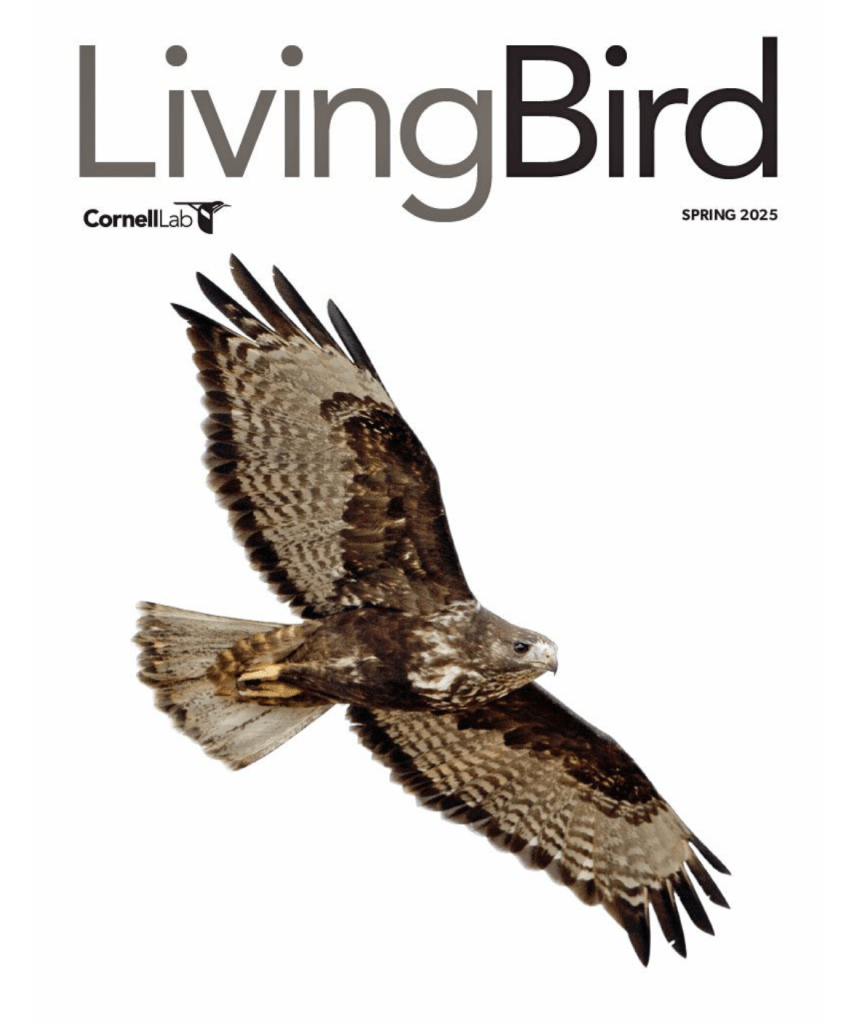
We are extremely excited to share that the Spring 2025 issue of the Cornell Lab of Ornithology’s Living Bird Magazine dons a spectacular photo of an adult Harlan’s Red-tailed Hawk (Buteo jamaicensis harlani) taken by Brian Sullivan, and includes a feature article focused on the work of the Red-tailed Hawk Project, written by the talented Scott Weidensaul!

The article is full of great images that bring much of the concepts that are the focus of our work to life. It’s well worth a read for those that know little about the species, and for those that know a lot and might enjoy considering all of the topics Scott discusses.

Be sure to read the article, and if aren’t already, become a member of the Cornell Lab and subscribe to Living Bird!

32 individuals make up the new cohort of transmitters for 2025!

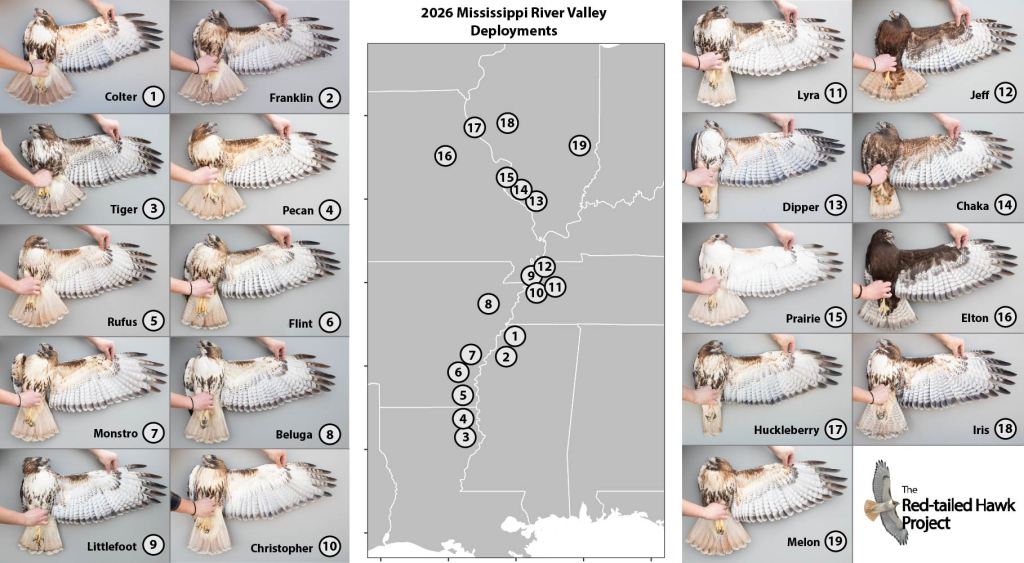
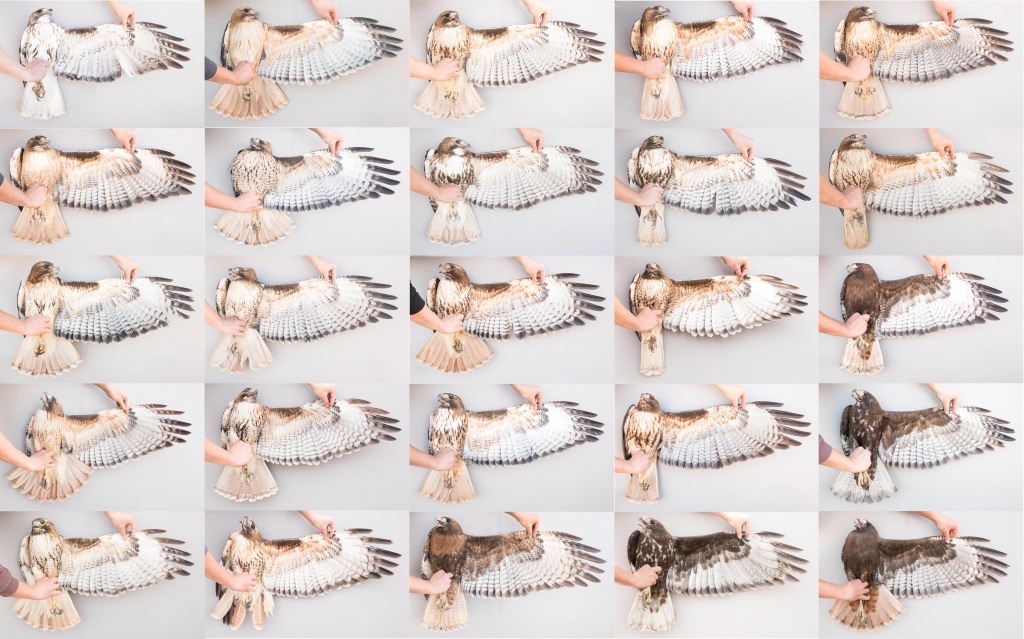
An excellent collage put together by Nicole showing 25 birds from the southwest United States that now carry transmitters. Click the photo to see more (including non-transmitter captures) in the Macaulay Library.

This season we have added 32 new transmitters to our tracking effort! This includes 25 from the desert southwest (see above), one dark morph in New York(!), and six birds in Washington (see below), all to represent our biggest seasonal transmitter effort yet! Our focus this season was primarily on bolstering our sampling of migratory individuals in the subspecies calurus. We focused our efforts on California, Arizona, and New Mexico, and came away with a nice variety of individuals that also included a few harlani. Many of these birds are already mid-way through their spring migration towards their breeding grounds.

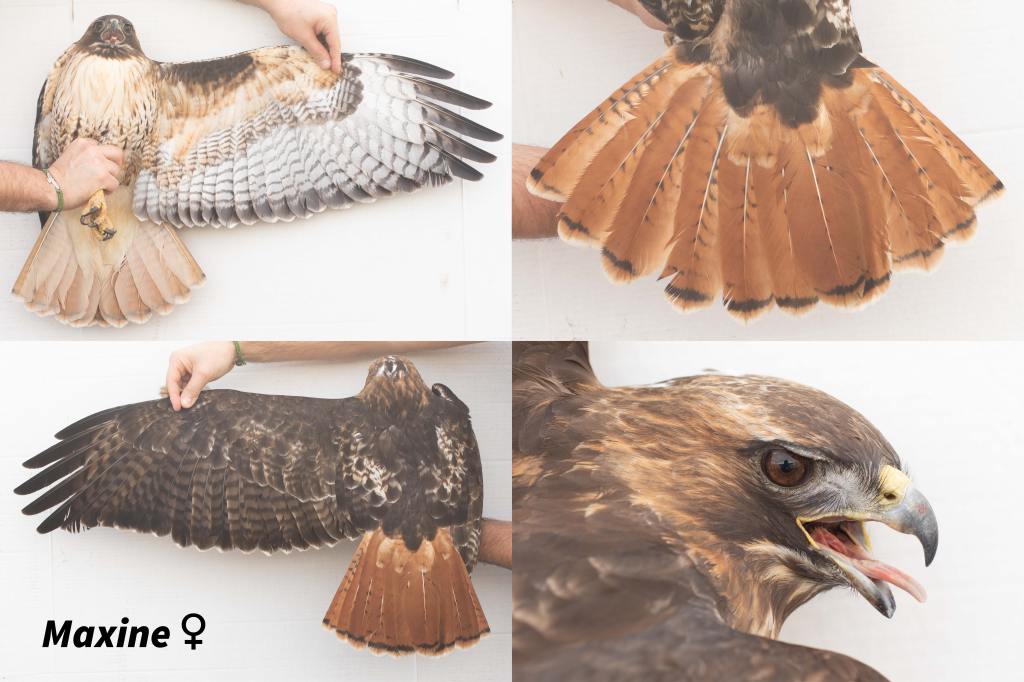
This adult dark morph (presumably abieticola) from New York now carries a transmitter! Click the photo to see more in the Macaulay Library.

We also had the extreme fortune to capture another dark morph adult in the eastern part of the continent in New York. This individual now represents the farthest east capture of a dark morph Red-tailed Hawk. The hope is that it will move north and become the farthest east known breeding location for the plumage type ever recorded, furthering our understanding of the distribution of polymorphism in the species and strengthening our ability to assess what factors drive this pattern.

An adult dark morph harlani from Washington that now carries a transmitter. Click on the photo to see more of this years birds from Washington. Special thanks to Jeff Kidd for his contribution to this effort!

Finally, we have added another handful of birds to our sampling in the Pacific Northwest. This includes a few harlani and non-harlani, which we hope will strengthen a perspective on what plumage types breed where, and how they are related.

Stay tuned for updates on this group, and how they all contribute to our research!I

A subspecies account for B. j. fuertesi

We’ve posted a new subspecies account for B. j. fuertesi, led by Brian Sullivan! – https://redtailedhawkproject.org/buteo-jamaicensis-fuertesi/

We continue to work on subspecies overviews for all described Red-tailed Hawk subspecies, so keep checking back for information on your favorite subspecies including the identification, taxonomic history, distribution, status, and our assessment of the current knowledge on the taxon. 

Since we plan to treat these accounts in a version type format where we conduct an annual review and update each account accordingly, we hope that these will represent the most up to date and correct information for understanding diversity within the Red-tailed Hawk (see this example of the type of information that might justify a revision – https://redtailedhawkproject.org/2024/09/12/published-in-the-journal-of-biogeography-a-revision-to-the-distribution-of-plumage-polymorphism-in-the-red-tailed-hawk-buteo-jamaicensis/).

Support our work by purchasing a shirt!

We have two shirt designs available that feature the described subspecies (light morphs only for the polymorphic taxon) as well as a dark morph harlani design. Consider supporting our work by purchasing a shirt, and carrying along a reference when you get out to look at Red-tailed Hawks!

To purchase either of these unisex shirt designs, follow the ‘shop’ link in the header of the website, or click on the shirt below!

A subspecies account for B. j. alascensis

We’ve posted a new subspecies account for the enigmatic B. j. alascensis, led by Brian Sullivan! – https://redtailedhawkproject.org/buteo-jamaicensis-alascensis/

We’re currently working on subspecies overviews for all described Red-tailed Hawk subspecies. These accounts will feature the identification, taxonomic history, distribution, status, and our assessment of the current status of our knowledge on the taxon.

Our idea is to treat these accounts in a version type format, where we conduct an annual review of each account and update accordingly, especially for those populations that we are currently focused on in our research (see this example of information we might need to incorporate for abieticolahttps://redtailedhawkproject.org/2024/09/12/published-in-the-journal-of-biogeography-a-revision-to-the-distribution-of-plumage-polymorphism-in-the-red-tailed-hawk-buteo-jamaicensis/).

Stay tuned for further detailed overviews of each described Red-tailed Hawk subspecies!

Published in the Journal of Biogeography – A revision to the distribution of plumage polymorphism in the Red-tailed Hawk (Buteo jamaicensis)

The Red-tailed Hawk Project’s first publication has now been published in the Journal of Biogeography! The paper details spring migration routes, nesting locations and home ranges of four dark morphs tagged in the Great Lakes region of North America. These data support that dark morphs do indeed breed in eastern Boreal Canada, extending our understanding of the distribution of plumage polymorphism for this species around 1500 km eastward.

There are many notable things included in this paper, apart from the evidence to suggest that the subspecies abieticola possesses a rare dark morph. This paper provides the first robust details on home range size during nesting for the species, as well as a perspective on age of first breeding (a few third-cycle or 3 year old birds in our dataset seem to have conducted nesting activities, while some did not, and all second-cycle or 2 year old birds did not).

Another notable aspect described in our data is the significantly different home range size for nesting male and female hawks. This is expected, since males provision incubating females. Still, it is very fun to see it represented in the data!

This paper is particularly exciting because of the inclusion of our standardized and comprehensive photographs of each individual that is included in the analyses in this paper (more photos of ‘Rose’ above, individual D4 in Figure 1 and the furthest east nesting dark morph Red-tailed Hawk, can be found in the Macaulay Library). In table 1 of the paper, we included the eBird checklists for each individual so the reader can easily explore the plumages and review our age assessments, for instance.

Finally, although we only include four dark individuals in this paper, we are extremely proud of that number because it represents hard work and collaboration. Our ability to create this publication only came through collaboration between Hawk Ridge Bird Observatory, Mackinac Straits Raptor Watch, and the Cornell Lab of Ornithology. Teamwork pays off!

You can read the paper online at https://doi.org/10.1111/jbi.15010