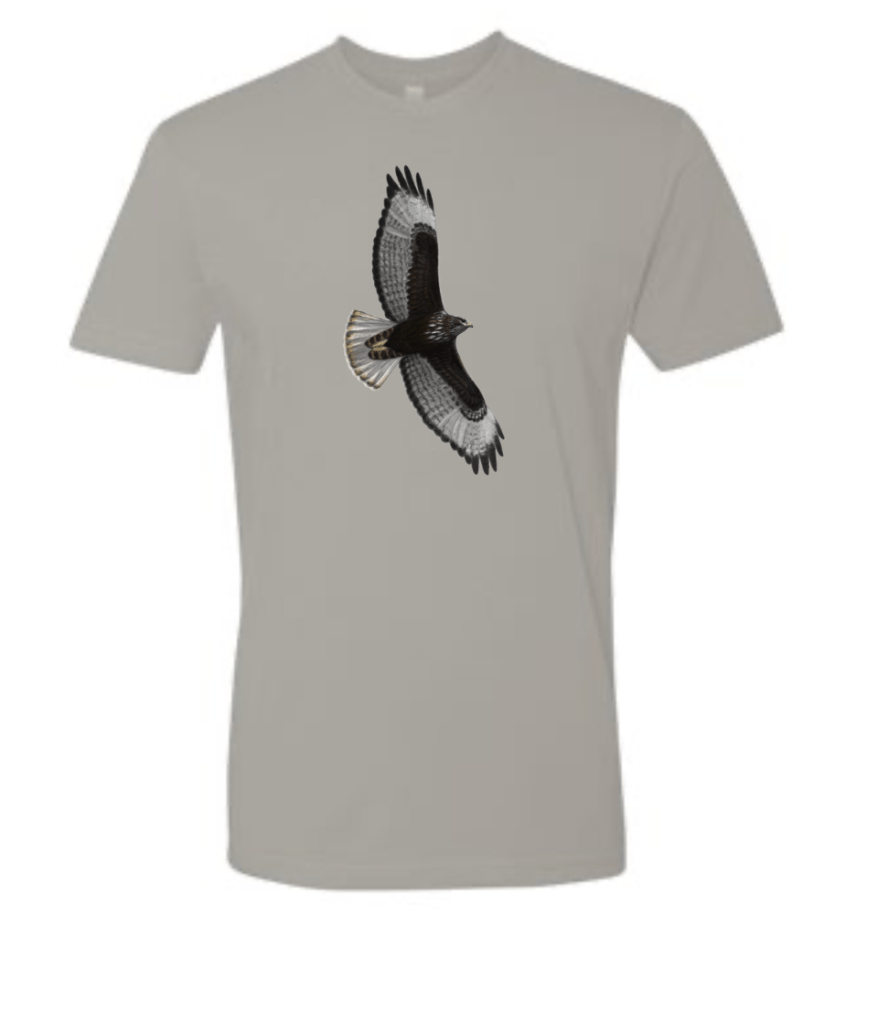
We have two shirt designs available that feature the described subspecies (light morphs only for the polymorphic taxon) as well as a dark morph harlani design. Consider supporting our work by purchasing a shirt, and carrying along a reference when you get out to look at Red-tailed Hawks!
To purchase either of these unisex shirt designs, follow the ‘shop’ link in the header of the website, or click on the shirt below!
We’re currently working on subspecies overviews for all described Red-tailed Hawk subspecies. These accounts will feature the identification, taxonomic history, distribution, status, and our assessment of the current status of our knowledge on the taxon.
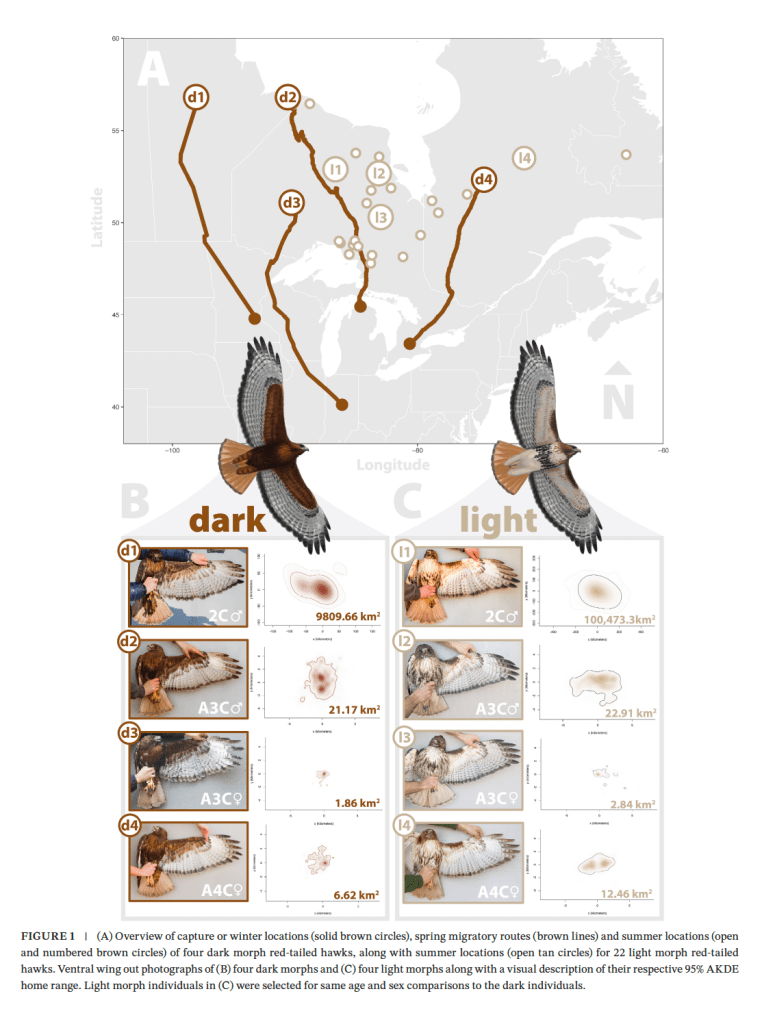
The Red-tailed Hawk Project’s first publication has now been published in the Journal of Biogeography! The paper details spring migration routes, nesting locations and home ranges of four dark morphs tagged in the Great Lakes region of North America. These data support that dark morphs do indeed breed in eastern Boreal Canada, extending our understanding of the distribution of plumage polymorphism for this species around 1500 km eastward.
There are many notable things included in this paper, apart from the evidence to suggest that the subspecies abieticola possesses a rare dark morph. This paper provides the first robust details on home range size during nesting for the species, as well as a perspective on age of first breeding (a few third-cycle or 3 year old birds in our dataset seem to have conducted nesting activities, while some did not, and all second-cycle or 2 year old birds did not).
Another notable aspect described in our data is the significantly different home range size for nesting male and female hawks. This is expected, since males provision incubating females. Still, it is very fun to see it represented in the data!
Finally, although we only include four dark individuals in this paper, we are extremely proud of that number because it represents hard work and collaboration. Our ability to create this publication only came through collaboration between Hawk Ridge Bird Observatory, Mackinac Straits Raptor Watch, and the Cornell Lab of Ornithology. Teamwork pays off!
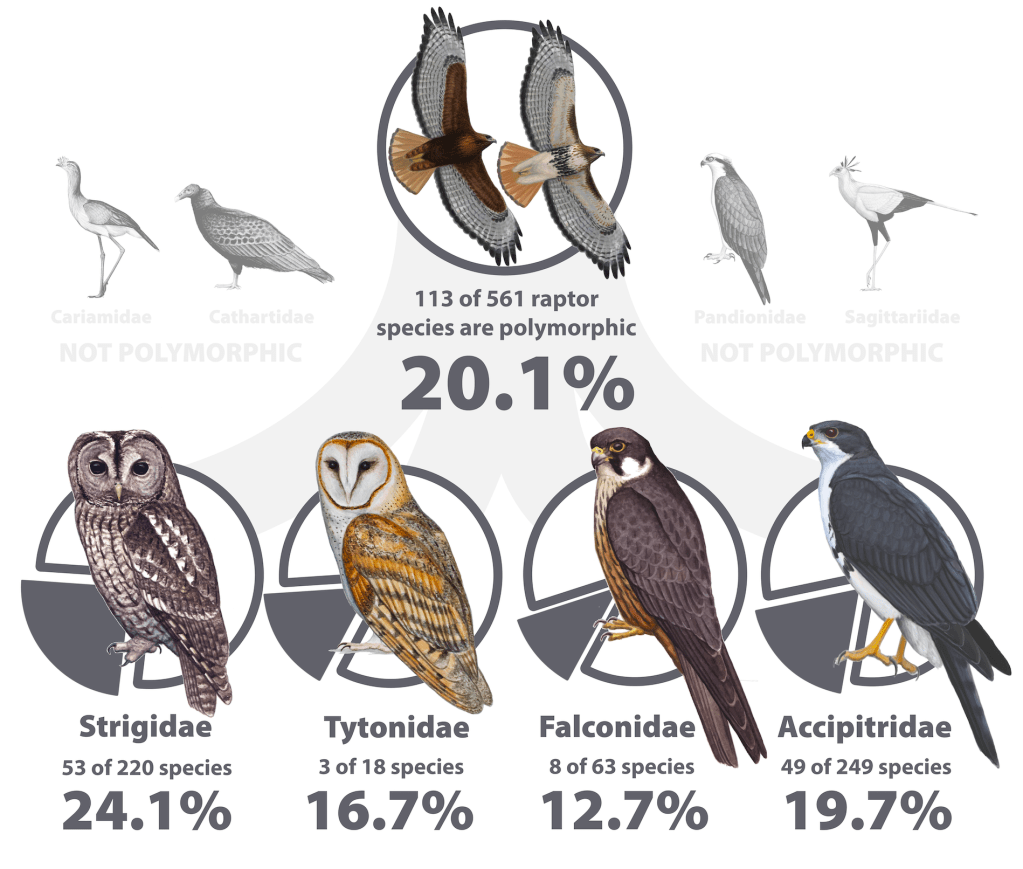
Why do some raptors, like the Red-tailed Hawk, have more than one color morph? Jen Walsh, Irby Lovette and the Red-tailed Hawk Project’s Bryce Robinson outline what is currently known in a publication now out in the journal Ornithology titled ‘Plumage polymorphism in raptors’. The paper details the presence of the trait in each raptor order and family, the hypotheses that have been tested to explain why it exists in some species, research focus by family, and the untouched potential of this group to continue to provide insights into why we see this pattern in raptors, predators, and animals in general.
This review provides great context for the work of the Red-tailed Hawk Project. Despite some fascinating patterns in the distribution of plumage polymorphism in the species, there has been very little work to try to understand what might explain its presence and absence in each population. The information outlined in this paper provides a helpful structure for what to consider and how to approach our investigation into factors that might explain plumage polymorphism in the Red-tailed Hawk.
We have already begun our work to put together an understanding of plumage polymorphism in the species, so stay tuned as we share our findings!
A few weeks ago, Bryce had the pleasure of presenting the project on the Cornell Lab of Ornithology’s Birds of the World Webinar. Take a look at how Bryce frames the work we are doing, and the updates he shares on what we’ve discovered so far!
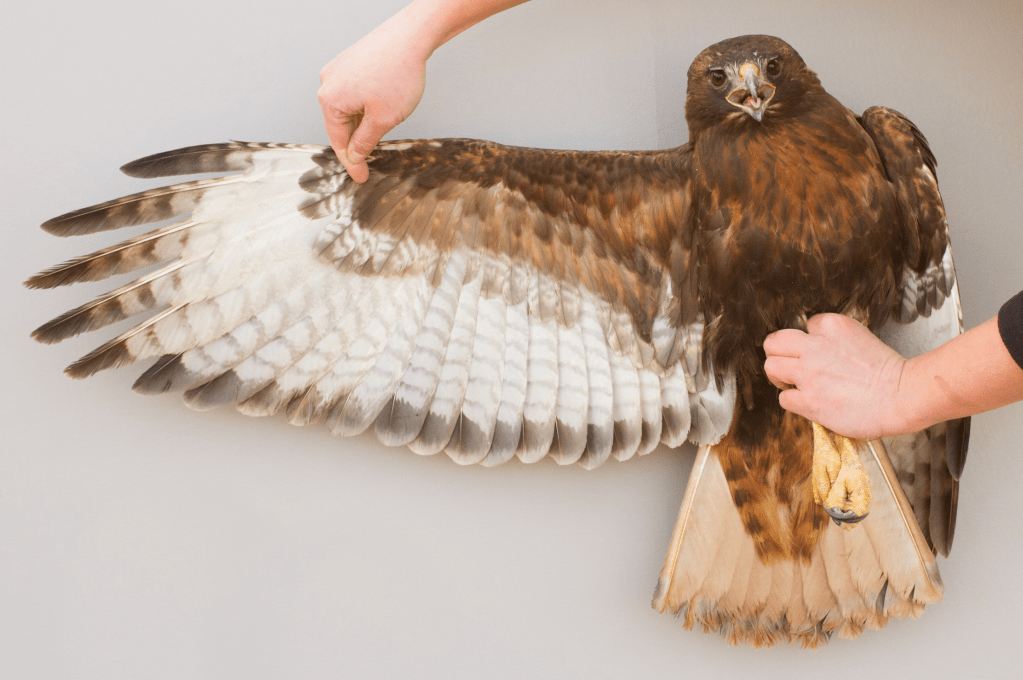
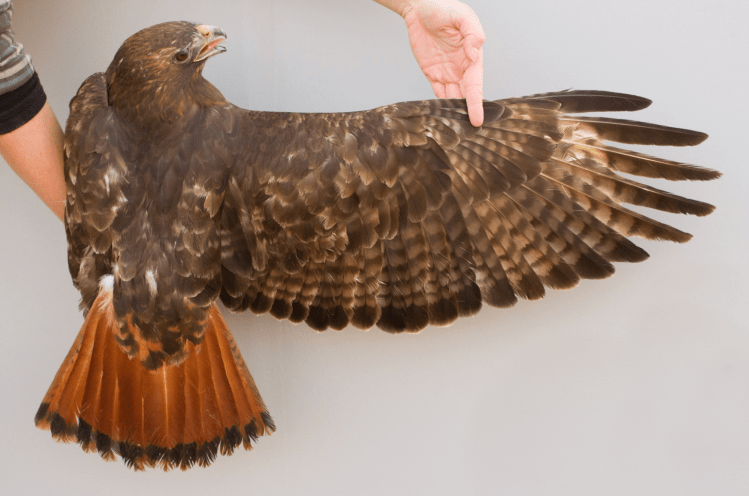
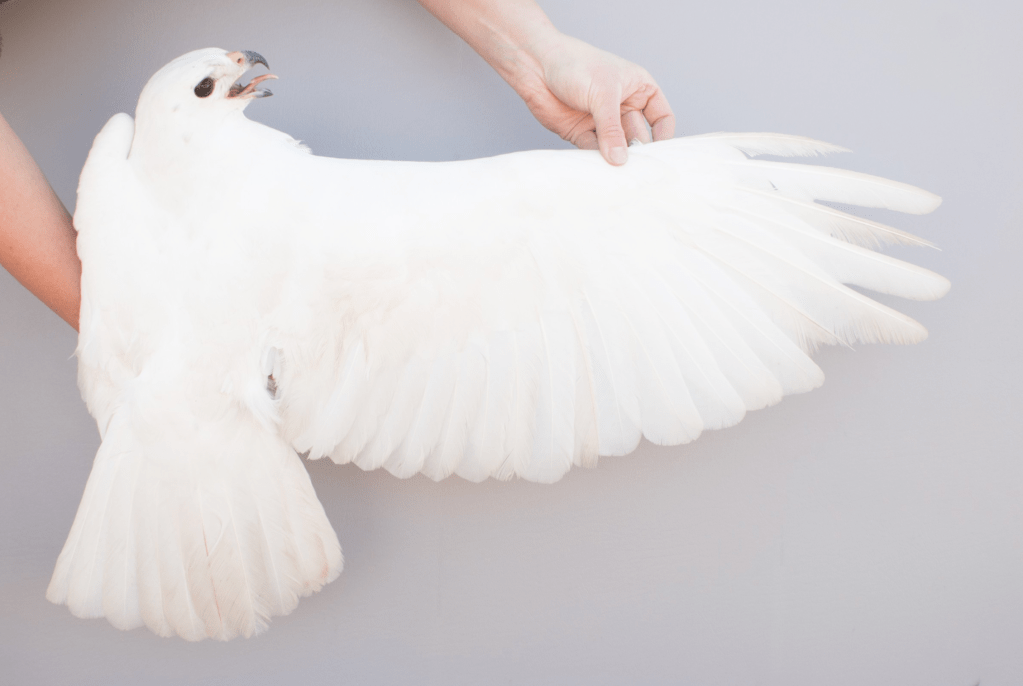
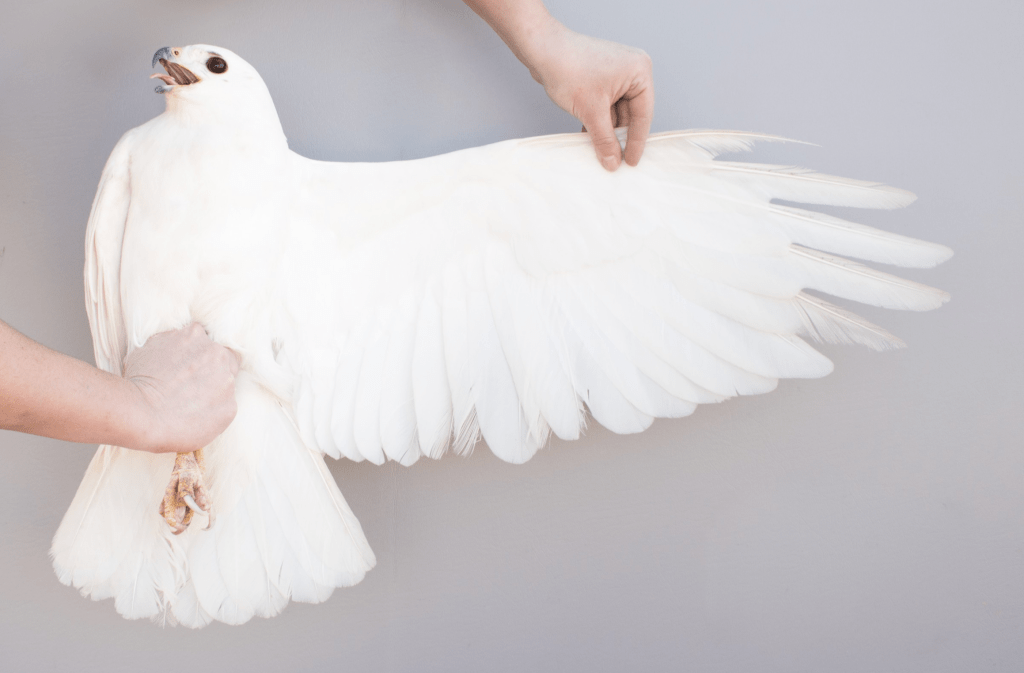
Some incredible luck struck on a recent trip to Oklahoma (more on the trip soon!) that included some core project folks as well as a few keen Cornell University undergraduate students. While on the trail to trap harlani and intergrade types, Irby Lovette and undergrad Mei Rao came across a striking all white Red-tailed Hawk. After the rest of the group caught up, we had the incredible fortune to capture the individual.
One very interesting take away from this individual is the importance of pigment for feather durability and structure. In both of the wing out images above, the molt limits in the primaries are strikingly obvious, with the old feathers being extremely worn. Without melanin in these feathers, they degrade substantially.
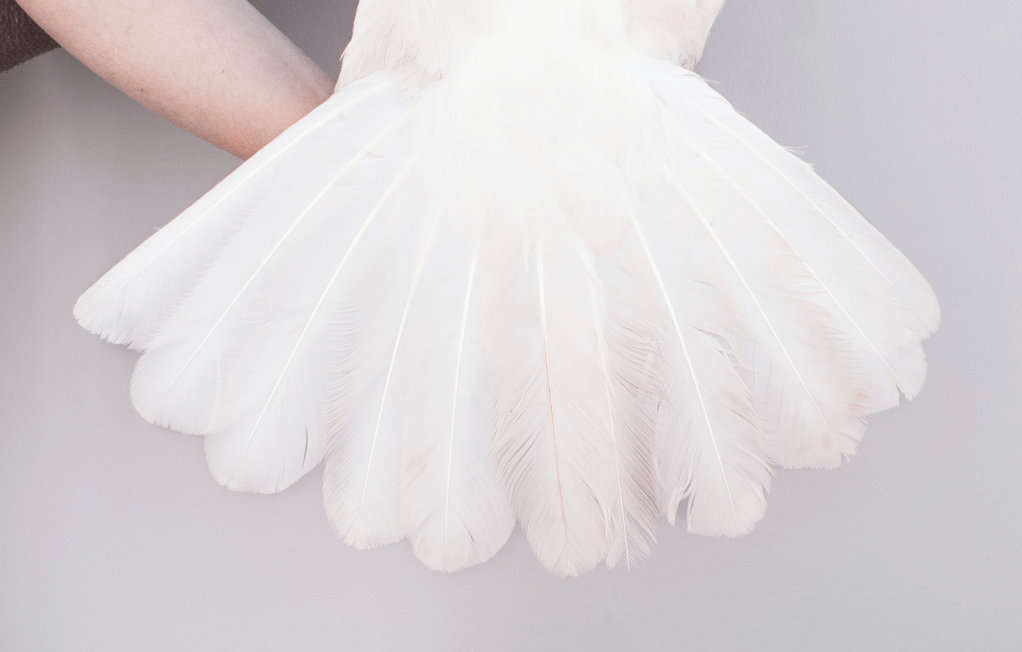
Another interesting note is that at first glance the bird appears to be entirely white, but there are flecks of color in a few locations on the body. In particular the bird has a few dark, fairly normally pigmented feathers on the nape, and the rachis of the central tail feather is partly pigmented orange. There are many mutations that might cause this look to a bird and it is impossible to know exactly without a molecular analysis, but because of the normally pigmented iris, bill, and the bits of color in the few locations on the body, we do know it is not albinism. Our guess is that the bird might be an example of a plumage aberration that slowly turns the bird white across its life called ‘Progressive Graying’.
Also notable to us were the white talons, with bits of pigment in a few. It is curious that the irises have normal pigment, and the bill seems to as well, but the talons are affected. Without knowing for certain at the moment, one supposition is that the rate of growth in the talons might be much higher than the bill, or perhaps the localized effect of the aberration is just random and for no reason other than chance has not affected the bill.
Because the individual lacks any plumage features, it is next to impossible to assign it to a subspecies or to know at all where this bird might breed (morphometrics do help, but not entirely). After some deliberation, the group decided to place a tracking unit on the bird. We’ll be sure to post about its full cycle wanderings when we receive the data, but our guess is that the bird is actually a harlani and ends up somewhere in Alaska this summer. We shall see!
One big component of the Red-tailed Hawk Project focuses on understanding movement ecology, including migratory, breeding and wintering ground movements. However, it is not feasible to put a transmitter on every bird we capture so in conjunction to our transmitter effort have put color bands on birds across their North American range. To effectively do this, individual researchers have a unique color combo to represent certain regions and the specific populations that move through those areas.
Nick, who bands migrants passing through the Straits of Mackinac in Michigan, uses white color bands that contain a black two digit alpha-numeric combo. Nick has been putting out color bands for two years now on breeding and non-breeding adults, and juveniles. One of our hopes with color banding juveniles is to see areas these non-breeders use throughout the year. We are also hoping to document the plumage progression in various subspecies as they molt from juvenile to adult plumage, something that remains a mystery because of the vast phenotypic variation among juveniles, especially among the subspecies abieticola.
Color banded 3Y in juvenile plumage (May 2023)
Photo Credit: Sharon Milligan
Color banded 3Y in adult plumage spotted in Jackson County, Mississippi
Now the exciting news. A juvenile abieticola that was banded in May of 2023 in the Straits region was recently resighted in Jackson County, Mississippi, near the Gulf of Mexico. This is also the furthest south we have had a Michigan migrant winter. With this we were able to document the change in plumage for what we would consider a more heavily marked juvenile of this subspecies.
Hopefully this has inspired you to look a little closer at the next Red-tail you see when you are out birding and to check and see if they too have a color band. If you do you can report the auxiliary marker (color band) here where you will be awarded a certificate for your effort and if you are lucky enough to get photos, please post those to Macaulay Library and ebird as these data are incredibly valuable.
The full set of photos for the resighted bird can be found here. I’d also like to thank Mike Borle for passing along this information about this resight from the Red-tailed Hawks of the United States Facebook page and of course Sharon Milligan for snapping some great shots of this bird!
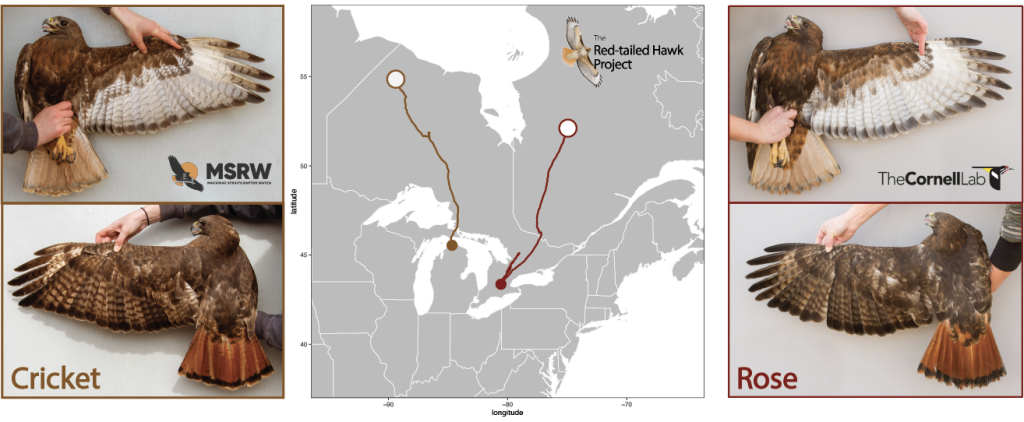
We’re currently celebrating some success from last years transmitter effort. Two of the dark birds we tagged, one that Nicole and Bryce caught in Ontario and one that Nick caught in Michigan, have returned for the winter and provided us with an insight into where they spent the summer. Both individuals spent their summer almost directly north of where they were caught, one in the northwest of Ontario and the other in the northern parts of Quebec (white circles in the figure).
Given their movements throughout the summer, we have reason to believe that both of these birds bred at these sites. In a forthcoming publication, we’ll outline their full cycle movements as well as provide an in depth description of their movements from the breeding season to support their breeding activities.
Does abieticola have a dark morph? An oversimplified answer seems to be yes, but we need to do more work to fully support this. The only way to confirm this is to do genomic analyses that will strengthen our understanding of the true origin of these dark types, and why we see them in the east at such a low frequency. For instance, these individuals could represent broad dispersal events from the west, and their offspring could face strong selective pressures that limit the true establishment of dark phenotypes in the east. The presence of these breeding adults may be explained by dispersal events that occur at such a frequency every generation but not result in the establishment of dark individuals that are genetically part of abieticola, or this far northeastern population of Red-tailed Hawks.
Our ability to put together this perspective on the origin of dark morphs that winter in the east is only possible through collaboration. Birders and ornithologists have wanted to answer the question of where these dark birds in the east originate for a long time, and the only way we have been able to uncover this is by working together. Under the Red-tailed Hawk Project, the Cornell Lab of Ornithology, Mackinac Straits Raptor Watch, and Hawk Ridge Bird Observatory, with support from the community, have all come together to answer this question. Stay tuned for a publication in the coming year that provides more details on these birds, and the coming genomic work that will help us further understand plumage polymorphism in this wonderful species.
Nicole and Bryce recently teamed up with a good friend of the project, Sylvain Bourdages, in Grande Prairie, Alberta for a week of exciting field work. An isolated patch of agricultural land surrounded by dense boreal forest, this area is a famous stopover for an incredible diversity and abundance of Red-tailed Hawks. At least, it is in a normal year! Sylvain has lived in the region two decades now, and has noticed that birds not only arrived later than usual, but were also relatively scarce overall this spring.
But in spite of the unusually quiet backroads, the week was a great success with twelve new transmitters deployed on an excellent suite of fascinating phenotypes. Now we eagerly wait to see where these birds will go to breed this summer!
We are fortunate that three of our birds have settled in summer locations that are in range of a cellular tower, so we are receiving regular updates on their movements. Two of these individuals took an exciting spring migratory route that we haven’t seen until now. Sefi and Ja’Marr moved along the coast of British Columbia and southeast Alaska, hopping from island to island and passing over cities such as Juneau. Eventually, both birds ended up in south central Alaska. Comparing these two individuals against Ragnar, who ended up at a breeding site in central British Columbia, creates an opportunity to look at the similarities and differences in their plumage, age, and purported sex to provide some interesting context to the movement patterns we are seeing.
These individuals are similar in many aspects of their plumage. They are all dark morphs, with fully red tails. Ja’Marr and Sefi each have harlani like streaking in the breast, while Ragnar is a very deep dark and solid brown throughout the body. The other striking difference is in the tail pattern, where Ragnar has rather thick and regular tail banding while the other two birds have irregular barring that is mostly restricted to the base of the tail, and includes harlani-like spotting. Although Ja’Marr is not breeding (as indicated by it’s more irregular and widespread movement patterns), it is interesting to compare the plumage similarities between Ja’Marr and Sefi, and the proximity to their summer locations, to Ragnar’s breeding location. These individuals are an important contribution to understanding whether or not birds like Sefi and Ja’Marr that occur well within the distribution of harlani represent the phenotypic diversity of that population, or represent plumage traits that come from calurus to the south, and occur because of contact and interbreeding.
The image above illustrates the home range pattern in a heat map for each individual for the month of June. The red clusters indicate areas of high use. Sefi seems to have nested in a site across the bay from Valdez, however there is some spread to the points. Contrasted against Ragnar, who also seems to have bred, the difference is striking. Ragnar has a very centralized, almost circular cluster pattern suggesting that the bird is tied tightly to a nest location. The difference between these two nesting patterns could be explained by sex. Based on morphometrics at the time of capture, Ragnar was tentatively sexed as a male while Sefi was tentatively sexed as a female. At face value, the patterns in their movements don’t make much sense considering their likely sex, since the female is more tied to the nest during the first part of the nesting period, while the male is more random in his movements as he works to provision the incubating female, and later, the young brood.
Ja’Marr’s movements are widespread, with multiple areas of high use. The lack of a centralized home range pattern suggests that Ja’Marr did not breed this summer. This makes sense, since the bird was a second-cycle at the time of capture this past winter. Generally, Red-tailed Hawk do not breed until the end of their third or fourth-cycle. Ja’Marr represents what is termed as a ‘floater’, or an individual that has not yet joined the breeding population. These floaters drift around until they find an opportunity to breed. If all goes well, we may capture when this occurs for this individual. Taken together with other birds we tagged as second-cycles, we can provide some very interesting insight into patterns of movement during the floater period, as well as the timing of recruitment into the breeding population.
Although at the moment we can only mostly speculate about the patterns we are seeing, we are situated to confirm most of our suspicions. For instance, we can confirm the sex of each individual using molecular techniques, and take a more systematic approach to analyzing the data to investigate what factors (such as sex, age, etc) best explain the movement patterns we see. There is a lot of exciting things to dig into, so stay tuned for more.







 Red-tailed Hawk Project